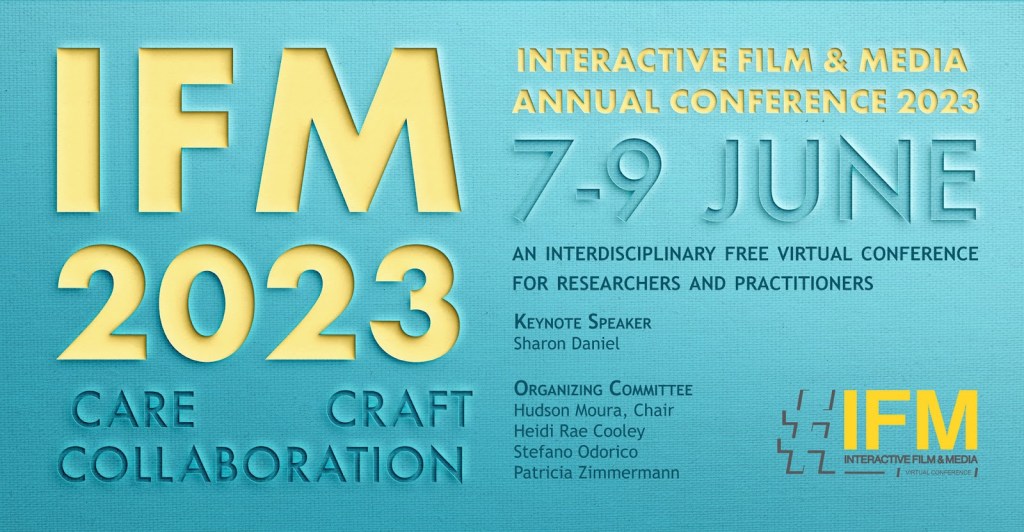
The #IFM2023 5th Interactive Film and Media Annual Conference, is taking place online, from the 7th tothe 9th of June 2023. It is dedicated to exploring ‘Care, Collaboration, and Craft’ in the realm of interactive film and media, bringing together contributions and exhibitions from over 50 presenters from 30 universities and labs worldwide.
Academics, practitioners, artists, designers, and producers in the field of interactive film and media are warmly invited to join this stimulating exploration. The conference is designed to harness the transformative power of diverse voices and methodologies, confronting the challenge of polarisation, while fostering diverse voices and inventing innovative, collaborative work practices.
Dr Polina Zioga will chair Panel IV, on Thursday, 8th of June, 18:00-19:30 PM (BST), on The Role of Text and Subtitles in Interactive Platforms and Multimedia Storytelling, Participatory Geographic Information Systems (PGIS), and Making a Riot in the Gaming Space!
The hybrid 5th International Conference on Digital Culture & AudioVisual Challenges (DCAC 2023), hosted by the Department of Audio & Visual Arts (Ionian University), is taking place in Corfu (Greece) and online, this week, 12-13 May 2023. The aim of DCAC 2023 is to bring together technology, art and culture in the Digital Era; provide a forum on current research and applications; and deepen cooperation, exchange experiences, and good practices.
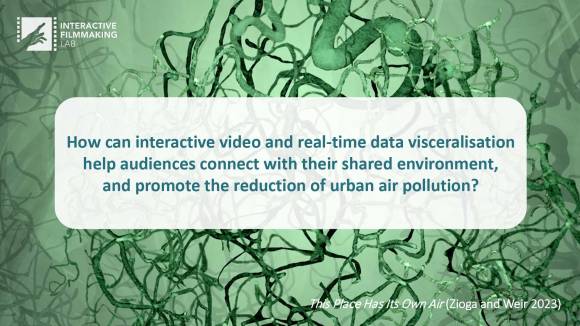
‘This Place Has Its Own Air’ proof of concept(Zioga and Weir 2023).
[…] This paper presents ‘This Place Has Its Own Air’, a data-driven video-installation and proof of concept for urban air quality data visceralisation. Its title is based on the seminal memoir The Living Mountain (1977) by Nan Shepherd, and is concerned with the effect of the city’s air (man-made polluted environment) on the body. The video-installation uses the real-time air quality data of the city where it is presented, to create an evocative visceralisation of the bodily experience; enabling viewers to have a real-time glimpse of the air they breathe and reflect on the need for reducing the pollution of their environment. […]
We have been quiet lately, but for a good reason. After more than five years of Research and Development in Interactive Film and Media, we have decided to take the next step in our journey and offer our services to you!
The reason is simple. The use of interactivity in the advertising, film and media sector is already driving the present and future ofaudience engagement. It creates new audience experiences and leverages new audience insight, but the development and production of interactive media and film can be complex and challenging, and the design of interactive audience research requires specialist expertise.
Whether you are a business interested in interactive advertising; a film and media company looking to develop an interactive production; a business or a filmmaker trying to better understand your audience, we offer:
Interactive Film, Media and Advertising Production
Interactive Media Consultancy
User Experience and Audience Research and Development
The #IFM2022 Virtual Conference is taking place online, from the 8th tothe 10th of June 2022. This year’s conference reunites academics and practitioners to explore the definitions, terms, practices and conditions of interaction and interactivity in three strands: epistemology, listening, and ecomedia. Apart from the paper presentations, the conference also includes several exhibitions of interactive films.
[…] our research focuses on the use of interactive video technologies, and factors that can lead into the design of engaging and user-friendly museum experiences for children. To achieve this, a museum was chosen as a case study and a survey was conducted. The results […] led to the production of Paintings Alive, an interactive film for children, based on the museum’s art gallery, and accessible on the visitors’ mobile devices. Our paper also discusses the findings of the project, alongside the challenges and limitations imposed by the COVID-19 pandemic, and offers recommendations for future work. […]
The invited talk was part of the ‘Digital Art, A New World’ art exhibition, presented by the Chicago Athenaeum: Μuseum of Architecture and Design, in collaboration with the European Centre for Architecture, Art, Design and Urban Studies, and the Project 2 Athens.
Zioga, P. (2022) ‘Digital Art and Neurosciences’. [Talk]. The European Centre/ Contemporary Space Athens, 20 May 2022.
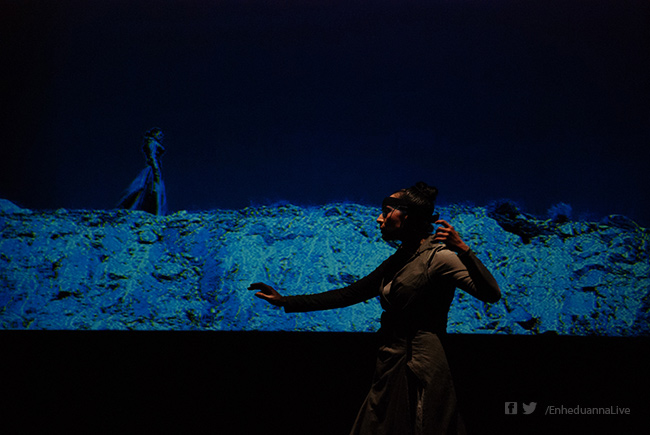
In producing Enheduanna: A Manifesto of Falling, which premiered in 2015, Zioga intercut verses from “The Exaltation” with words by Maya Angelou, Virginia Woolf, Theodore Adorno, Pavlina Pamboudi, Marguerite Yourcenar and other writers. The 50-minute mixed-media event broke technological ground […]: As video projections filled a screen, the show’s solo performer and audience members […] wore […] headsets that intermittently picked up brain activity and colored the stage in real time accordingly to the results. […] It was the premiere of a live, brain-computer interface performance, and in it the world’s first author seemed right at home. “The Exaltation,” says Zioga, “is one of these works that is safe to describe as universal and timeless, and therefore contemporary.”
A new (and free!) book is now available: ‘The Formation of Film Audiences’ conference proceedings, edited by Lito Tsitsou, Helen Rana and Bridgette Wessels, address many aspects that feature in the ways in which film audiences form in the early 21st century – across distribution, exhibition and audience experience.
The proceedings include a selection of the papers presented at the Beyond the Multiplex: Understanding the Value of a Diverse Film Culture conference that cover the diversity of cinema and highlight the richness of film audience experience, bringing practice, policy and academic perspectives into the debate. They address the curation aspect of cinema (Rachel Hayward and Andy Willis); the role of digital access to film in relation to collective audience experiences (Andy Moore); the cultural history of ‘industry landscapes’ and ‘industry histories’ in the evolution of the independent documentary sector in the thirty-year period to 2020 (Alice Quigley and Steve Presence); the audience engagement and development at Town and Gown cinemas (Dominic Topp and Lavinia Brydon); and the ways in which interaction design for audiences can help in building resilience and supporting the COVID-safe recovery of independent cinemas (Polina Zioga and María A. Vélez-Serna).
Here at the Interactive Filmmaking Lab, we have started the New Year with new publications! Hot off the press:
Clarke, A. and Zioga, P. (2022) Scriptwriting for Interactive Crime Films: the Case of Scapegoat. Interactive Film And Media Conference 2021: New Narratives, Racialization, Global Crises, And Social Engagement, Online. Interactive Film and Media Journal, 2(1): 106-121. doi: 10.32920/ifmj.v2i1.1524.
In recent years, the increasing number of interactive films being released, has highlighted the need for further development of methods and criteria that can guide the earlier stages of development, such as the scriptwriting process. Following the framework of interactive storytelling as a spectrum, it is acknowledged that writing a script for an interactive narrative that involves branching path options, or multiple endings, is becoming more common and presents its own challenges. […]
[…] interaction design and technologies can help independent cinemas to engage and galvanise new audiences to patronise COVID-safe venues. From low-end online platforms to high-end immersive experiences, new technologies are transforming connectivity across society, and have the potential to support access for D/deaf, neurodivergent, and disabled audiences, but adoption by exhibitors is so far limited. We outline the research needs and priorities in this field. These include identifying facilitators and obstacles to industry adoption of interactive forms, and mapping experiences and attitudes across the sector. Together with directions for immediate practical solutions, it is crucial to gather critical data for future research use, in order to pave the way for long-term solutions and design innovation, so that the sector can build resilience, recover and reach underserved audiences.
The article will be published as part of the Proceedings of the Conference ‘Audiences beyond the multiplex: understanding the value of a diverse film culture’ that took place in March 2021. You can read the full article here.
From the 5th to the 7th of August 2021, the ‘Interactive Film and Media 2021’ conference is taking place online. This virtual edition on ‘new narratives, racialization, global crises, and social engagement’ aims to reflect on the recent changes to the mediascape and the closely related medium of interactive narrative, in its many forms and iterations; and consider the advantages and drawbacks of the current trends in film, media, and interactive narratives.
In recent years, the increasing number of interactive films being released, has highlighted the need for further development of methods and criteria that can guide the earlier stages of development, such as the scriptwriting process. Following the framework of interactive storytelling as a spectrum, it is acknowledged that writing a script for an interactive narrative that involves branching path options, or multiple endings, is becoming more common and presents its own challenges. […]
At a key moment for film exhibition, the conference raises questions about how we might think differently about audiences and their relationship with film, and how these insights can support audience development.
Zioga, P., and Vélez-Serna, M.A. (2021) ‘Interaction Design for Audiences: A Proposition for Building Resilience and Recovery for COVID-safe Independent Cinemas’. In: Audiences beyond the multiplex: understanding the value of a diverse film culture. Glasgow, UK, 2-3 March 2021.
[…] interaction design and technologies can help independent cinemas to engage and galvanise new audiences to patronise COVID-safe venues. From low-end online platforms, to high-end immersive experiences, new technologies are transforming connectivity across society, and have the potential to support access for D/deaf, neurodivergent, and disabled audiences, but adoption by exhibitors is so far limited. We outline the research needs and priorities in this field. These include identifying facilitators and obstacles to industry adoption of interactive forms, and mapping experiences and attitudes across the sector. Together with directions for immediate practical solutions, it is crucial to gather critical data for future research use, in order to pave the way for long-term solutions and design innovation, so that the sector can build resilience, recover and reach underserved audiences.
You can find more information about the conference here, together with the free registration.



 Interactive Filmmaking Lab®