Categories
Audiences Brain-Computer Interfaces Interactive Media Live Brain-Computer Cinema Methods Participants People Publications Research UX

Celebrating Pioneering Women in Interactive Arts & Neurotechnologies

Today, on International Women’s Day, we celebrate the pioneering women who have opened new horizons in the fields of interactive arts and neurotechnologies! As a woman- and diverse-led team, we pay tribute to the women that have shaped the landscape of brain-computer interaction and neuroscience in interactive storytelling and the arts, and have inspired our own work.

Nina Sobell and Jaqueline Humbert are early pioneering artists, and amongst the first to design Brain-Computer Interaction applications. Sobell’s Brainwave Drawings (1972) – probably the first work of moving image with the use of a Brain-Computer Interface (BCI), and Humbert’s Alpha Garden installation (1973) and Brainwave Etch-a-Sketch drawing game (1974), are seminal works, laying the groundwork for future explorations in the field. Read more…

In more recent years, advancements in neuroscience and technology have enabled artists to create works that express their inner experiences and the feeling of being connected with their audience. Claudia Robles-Angel is an audio-visual and new media artist pushing the boundaries of audience interaction in multimedia performances. Her INsideOUT (2009) audio-visual performance used her own brain-activity to generate images and sound. Read more…

Mariko Mori has used the simultaneous interaction of more than one participant with the use of BCIs in the Wave UFO immersive video installation (2023). While the iconic performance artist Marina Abramovic collaborated with neuroscientist Dr Suzanne Dikker in projects like Measuring the Magic of Mutual Gaze (2011), The Compatibility Racer (2012) and The Mutual Wave Machine (2013), demonstrating the power of multi-brain BCIs in facilitating simultaneous interaction between participants. Read more…

As we celebrate the contributions of these remarkable women, and their dedication to pushing the boundaries of art, science, and technology, let’s continue to honour and amplify the voices of women in interactive media and beyond!

Categories
Art Exhibition Brain-Computer Interfaces Live Brain-Computer Cinema News People Research

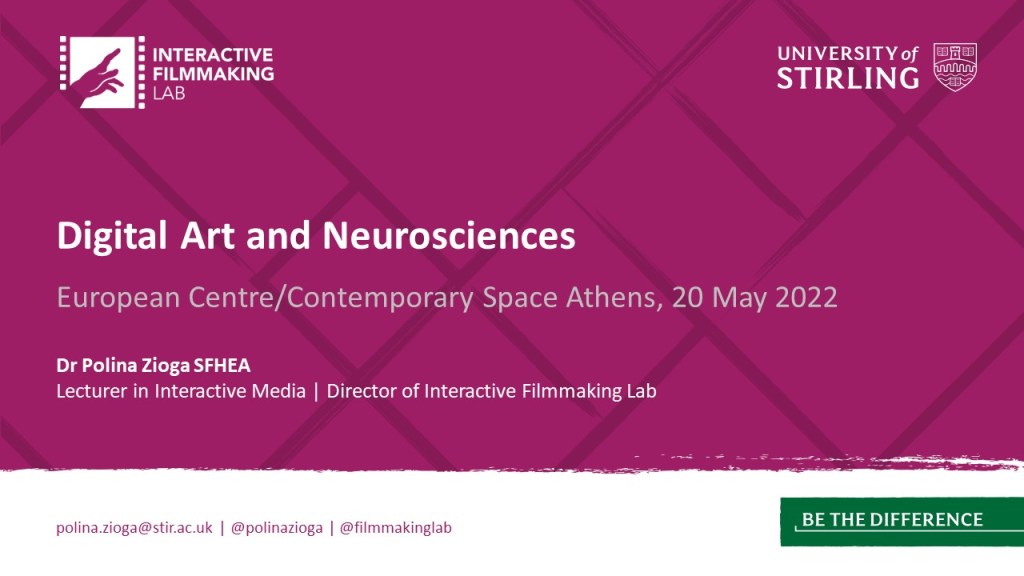
‘Digital Art and Neurosciences’

Dr Polina Zioga was invited to speak about ‘Digital Art and Neurosciences’, at The European Centre/Contemporary Space Athens (74 Mitropoleos Street, Historical Centre of Athens, Greece), on the 20th of May 2022, and presented the ‘Live Brain-Computer Cinema’ research project and her work on ‘Enheduanna: A Manifesto of Falling’ Live Brain-Computer Cinema Performance.

The invited talk was part of the ‘Digital Art, A New World’ art exhibition, presented by the Chicago Athenaeum: Μuseum of Architecture and Design, in collaboration with the European Centre for Architecture, Art, Design and Urban Studies, and the Project 2 Athens.

Zioga, P. (2022) ‘Digital Art and Neurosciences’. [Talk]. The European Centre/ Contemporary Space Athens, 20 May 2022.
Categories
Brain-Computer Interfaces Interactive Filmmaking Live Brain-Computer Cinema Live Cinema News People Performance Publications Research

‘Was Enheduanna the World’s First Author?’ AramcoWorld Magazine

The ‘Live Brain-Computer Cinema’ research project was featured in the AramcoWorld magazine’s March / April 2022 issue. Dr Polina Zioga was interviewed by Lee Lawrence for her work on  ‘Enheduanna: A Manifesto of Falling’ Live Brain-Computer Cinema Performance, the ‘50-minute mixed-media event [that] broke technological ground’.

In producing Enheduanna: A Manifesto of Falling, which premiered in 2015, Zioga intercut verses from “The Exaltation” with words by Maya Angelou, Virginia Woolf, Theodore Adorno, Pavlina Pamboudi, Marguerite Yourcenar and other writers. The 50-minute mixed-media event broke technological ground […]: As video projections filled a screen, the show’s solo performer and audience members […] wore […] headsets that intermittently picked up brain activity and colored the stage in real time accordingly to the results. […] It was the premiere of a live, brain-computer interface performance, and in it the world’s first author seemed right at home. “The Exaltation,” says Zioga, “is one of these works that is safe to describe as universal and timeless, and therefore contemporary.”

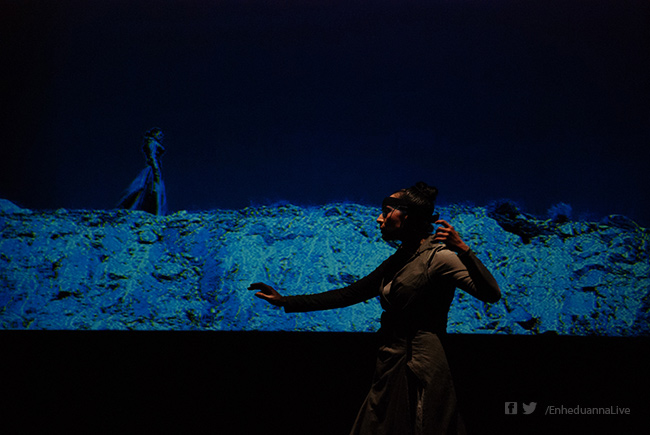
Enheduanna – A Manifesto of Falling’ Live Brain-Computer Cinema Performance featuring Anastasia Katsinavaki at CCA Glasgow, July 2015. Photography: Catherine M. Weir. ©2015 Polina Zioga and Catherine M. Weir.

You can read the full article here.

Categories
Brain-Computer Interfaces Live Brain-Computer Cinema Live Cinema News People Research

‘Will mind-controlled films change cinema?’ Chips with Everything – The Guardian podcast

Dr Polina Zioga has been invited to talk about the future of cinema and how audiences can use their brain-activity to control a film in The Guardian podcast Will mind-controlled films change cinema? Chips with Everything.

Charlie Chaplin, known for the slapstick humour of his films, was part of a generation of actors who managed to continue working through the transition from the era of silent film to one filled with dialogue and sound.

The introduction of sound wasn’t the only way that people revolutionised cinema, and it won’t be the last.

So what does the history of cinema tell us about the evolution of technology in the arts?

And how can brain activity be used to change the plot of a film? Is there a place for the traditionally passive experience of watching a film to become more interactive, or will that detract from what we value about cinema? […]

You can listen to the podcast on The Guardian.

Categories
Brain-Computer Interfaces Live Brain-Computer Cinema Live Cinema News People Research

Dr Polina Zioga at the Mixed Reality Laboratory (University of Nottingham)

Dr Polina Zioga has been invited to give a guest talk at the Mixed Reality Laboratory (MRL) of the University of Nottingham. The MRL was established in 1999 and is the home of over sixty academics, research associates and PhD students.

Location: Mixed Reality Lab Meeting Space, Jubilee Campus, University of Nottingham.
Date: Friday, 15 June 2018, 12:00-13:00.
More information: www.nottingham.ac.uk/research/groups/mixedrealitylab/events/lab-meetings/2018-06-15.aspx

Multi-Brain BCI Interaction for Live Cinema: Performer and Audience Participation, Cognition and Emotional Engagement
[…] ’Enheduanna—A Manifesto of Falling’, a live brain-computer cinema performance, enabled for the first time the simultaneous real-time multi-brain interaction of more than two participants, including a performer and members of the audience, using a passive EEG-based BCI system. The event was realised as a neuroscientific study conducted in a real-life setting. The results obtained from the participants’ data analysis reveal new information and contribute on new hypotheses about the effects of the length of time, but also the role of the directing strategy, dramaturgy and narrative structure on the performer’s and audience’s perception, cognitive state, and engagement.

Read the full announcement here.

Categories
Brain-Computer Interfaces Live Brain-Computer Cinema Live Cinema News People Publications Research

‘New research shows how brain-computer interaction is changing cinema’

Dr Polina Zioga writes for The Conversation:

Over the past few years, we have seen the extraordinary development of neural prosthetic technologies that can replace or enhance functions of our central nervous system. For example, devices like Brain-Computer Interfaces (BCIs) allow the direct communication of the brain with a computer. The most common technique applied in these devices, is Electroencephalography (EEG) – a recording of the electrical activity along the scalp.

These technologies are mainly used in health, but our new research shows how they are changing the future of cinema too.

Read the full article on The Conversation.

Categories
Brain-Computer Interfaces Live Brain-Computer Cinema Live Cinema News People Publications Research

New Open Access Original Research article in Frontiers in Neuroscience, Special Issue ‘Futuristic Neural Prostheses’

“Enheduanna—A Manifesto of Falling” Live Brain-Computer Cinema Performance: Performer and Audience Participation, Cognition and Emotional Engagement Using Multi-Brain BCI Interaction
Polina Zioga1*, Frank Pollick2, Minhua Ma1, Paul Chapman3 and Kristian Stefanov1,2

1Interactive Filmmaking Lab, School of Computing and Digital Technologies, Staffordshire University, Stoke-on-Trent, United Kingdom
2Perception Action Cognition Lab, School of Psychology, University of Glasgow, Glasgow, United Kingdom
3School of Simulation and Visualisation, Glasgow School of Art, Glasgow, United Kingdom

Abstract: The fields of neural prosthetic technologies and Brain-Computer Interfaces (BCIs) have witnessed in the past 15 years an unprecedented development, bringing together theories and methods from different scientific fields, digital media, and the arts. More in particular, artists have been amongst the pioneers of the design of relevant applications since their emergence in the 1960s, pushing the boundaries of applications in real-life contexts. With the new research, advancements, and since 2007, the new low-cost commercial-grade wireless devices, there is a new increasing number of computer games, interactive installations, and performances that involve the use of these interfaces, combining scientific, and creative methodologies. The vast majority of these works use the brain-activity of a single participant. However, earlier, as well as recent examples, involve the simultaneous interaction of more than one participants or performers with the use of Electroencephalography (EEG)-based multi-brain BCIs. In this frame, we discuss and evaluate “Enheduanna—A Manifesto of Falling,” a live brain-computer cinema performance that enables for the first time the simultaneous real-time multi-brain interaction of more than two participants, including a performer and members of the audience, using a passive EEG-based BCI system in the context of a mixed-media performance. The performance was realised as a neuroscientific study conducted in a real-life setting. The raw EEG data of seven participants, one performer and two different members of the audience for each performance, were simultaneously recorded during three live events. The results reveal that the majority of the participants were able to successfully identify whether their brain-activity was interacting with the live video projections or not. A correlation has been found between their answers to the questionnaires, the elements of the performance that they identified as most special, and the audience’s indicators of attention and emotional engagement. Also, the results obtained from the performer’s data analysis are consistent with the recall of working memory representations and the increase of cognitive load. Thus, these results prove the efficiency of the interaction design, as well as the importance of the directing strategy, dramaturgy and narrative structure on the audience’s perception, cognitive state, and engagement.

Keywords: live brain-computer cinema performance, brain-computer interface (BCI), multi-brain interaction, electroencephalography (EEG), performer, audience participation, attention, emotional engagement

Complete article available on: frontiersin.org/articles/10.3389/fnins.2018.00191

Citation: Zioga P, Pollick F, Ma M, Chapman P and Stefanov K (2018) “Enheduanna—A Manifesto of Falling” Live Brain-Computer Cinema Performance: Performer and Audience Participation, Cognition and Emotional Engagement Using Multi-Brain BCI Interaction. Front. Neurosci. 12:191. doi: 10.3389/fnins.2018.00191

Received: 18 October 2017; Accepted: 09 March 2018; Published: 03 April 2018.

Edited by: Fivos Panetsos, Complutense University of Madrid, Spain
Reviewed by: Jing Jin, East China University of Science and Technology, China; Celia Herrera-Rincon, Tufts University, United States

Copyright © 2018 Zioga, Pollick, Ma, Chapman and Stefanov. This is an open-access article distributed under the terms of the Creative Commons Attribution License (CC BY). The use, distribution or reproduction in other forums is permitted, provided the original author(s) and the copyright owner are credited and that the original publication in this journal is cited, in accordance with accepted academic practice. No use, distribution or reproduction is permitted which does not comply with these terms.