
The Interactive Filmmaking Lab® has developed its own in-house research, translating empirical study into innovative interactive film and media experiences. From the very beginning, our focus has been on conducting in-house studies, grounded in creative research and user-centred design, so that every project, and interface are both original and ethically developed. In this post, we would like to share how our independent research underpins our creative practice, and invite you to explore our Publications page for full details of our scholarly outputs.
From Questions to Compelling Narratives
Building on early studies into audience interaction, and interactive narratives, we have developed new methods for dynamic storytelling, creating projects that respond to participant and viewer input, environmental and biometric data.
But before we begin writing scripts or sketching interface mock-ups, we identify a set of core questions.
_____
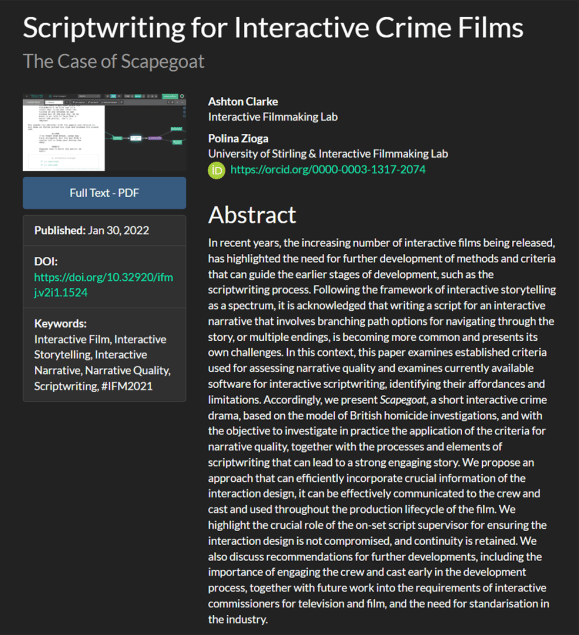
Image: Clarke, A., and Zioga, P. (2022) Scriptwriting for Interactive Crime Films: the Case of Scapegoat. Interactive Film And Media Conference 2021: New Narratives, Racialization, Global Crises, And Social Engagement, Online. Interactive Film and Media Journal, 2(1): 106-121. doi: 10.32920/ifmj.v2i1.1524.
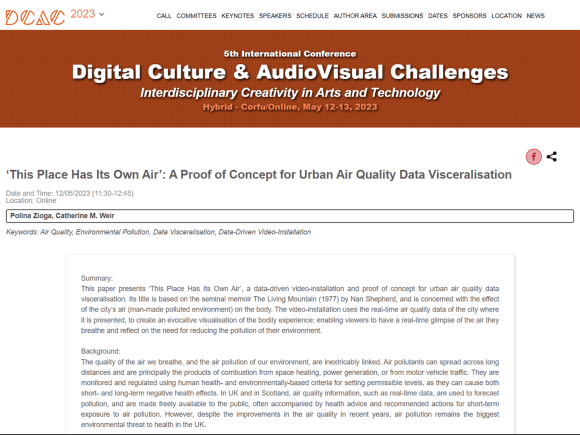
For example, for This Place Has Its Own Air, we asked: ‘How can interactive video and real-time data visceralisation help audiences connect with their shared environment, and promote the reduction of urban air pollution?’. Our subsequent in-house study combined data visualisation, human-computer interaction, interactive media and video, resulting in a site-specific data-driven video-installation, which premiered at SPARK Festival 2024 in Hong Kong (October 2024).
_____
Image: Zioga, P. and Weir, C. M. (2023) ‘This Place Has Its Own Air’: A Proof of Concept for Urban Air Quality Data Visceralisation. In: DCAC 2023 5th International Conference on Digital Culture & AudioVisual Challenges. Corfu, Greece & Online, May 12-13 2023.
Iterative Prototyping: Theory Meets Practice
We firmly believe that research should never be an afterthought. Our development cycle emphasises iterative prototyping. By embedding research from day one, we ensure that creativity and rigour develop in parallel. Every hypothesis is tested through low-fidelity prototypes, and feedback loops inform subsequent design decisions. By maintaining full control over our methodology and deliverables, we ensure that our interactive films and media productions not only captivate audiences but also advance the broader discourse around media, technology and human experience.
_____
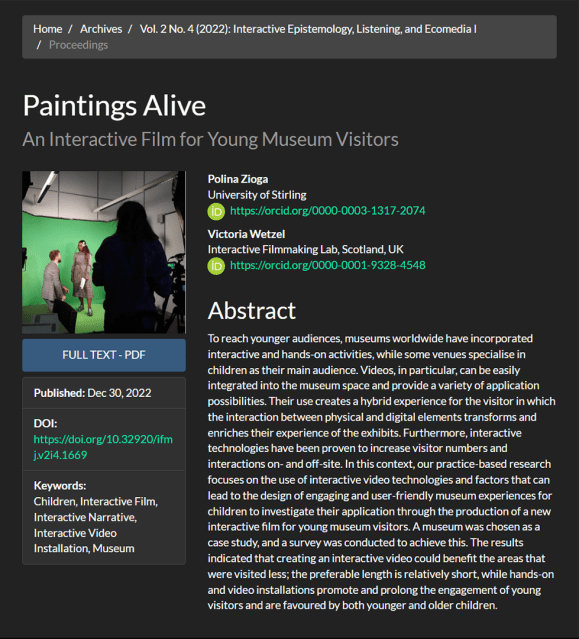
Image: Wetzel, V., and Zioga, P. (2022) Paintings Alive: An Interactive Film for Young Museum Visitors. Interactive Film and Media Journal, 2(4): 95-105. doi: 10.32920/ifmj.v2i4.1669.
Learn More
Curious about the studies that inform our work? Visit our Publications page, where you will find comprehensive write-ups of our research on audience participation and interaction, interactive storytelling, adaptive narratives, data visceralisation, user-experience design and more. You can find download links, full citation information and details of outlets.
_____
Image: Zioga, P. and Vélez-Serna, M.A. (2022) ‘Interaction Design for Audiences: A Proposition for Building Resilience and Recovery for COVID-safe Independent Cinemas’. In: Tsitsou, L., Rana, H. and Wessels, B. (Eds.) (2022) The Formation of Film Audiences: Conference Proceedings. University of Sheffield: The Digital Humanities Institute.
Stay Connected
Want to stay in the loop?
- Subscribe to our blog for project updates and behind-the-scenes insights.
- Follow us on social media for the latest announcements.
Have questions about our methodology or want to explore a research-driven collaboration? Contact our team. We are always eager to discuss new ideas and partnerships.
 Interactive Filmmaking Lab®